
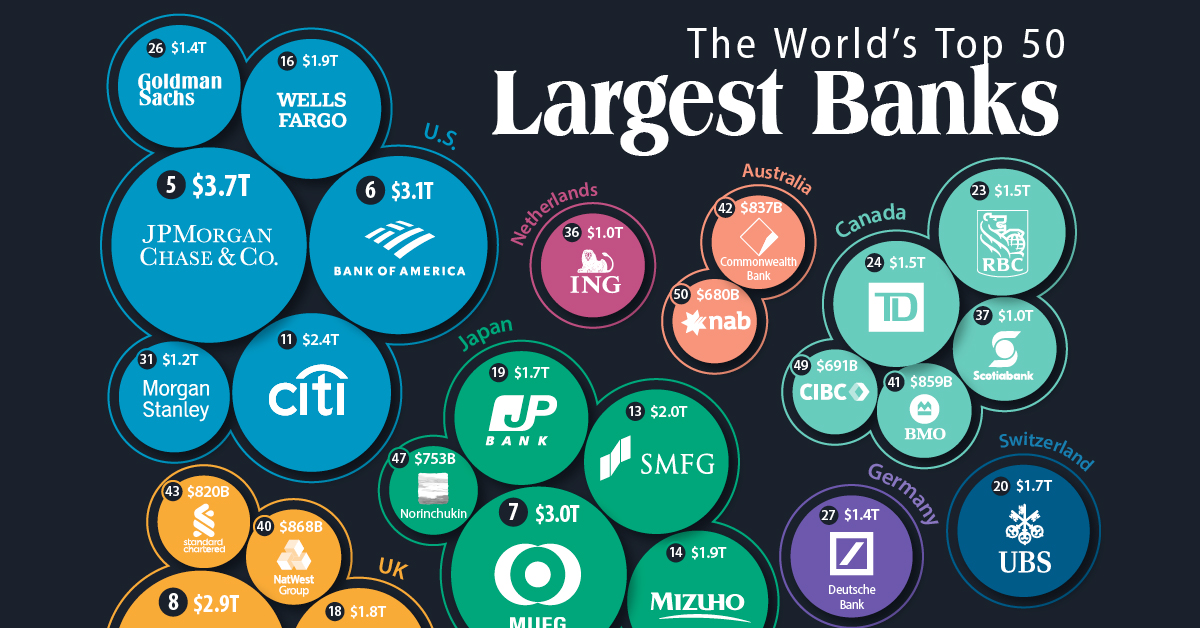
The 20 largest banks in the United States include some names you’ve probably heard before, like Bank of America and Wells Fargo. 20 Largest Banks in the U.S.
The list also includes banks that aren’t as well-known across the country, like Truist, TD Bank, and State Street.
The ranks change every year as upstart banks with better online banking features and higher savings yields poach customers from tradition-bound institutions that don’t innovate as quickly.

Getting Access to funds when you need it just got easier
Get $5,000 Venmo Transfer Click Here
Get Instant $10,000 Zelle Transfer Click Here
Get $10,000 USD Cashapp Transfer Click Here
These are the 20 largest banks in the United States by total assets.
Each entry includes some additional information: 20 Largest Banks in the U.S.
- Headquarters. Some banks have two headquarters, one for their official charter location and one for their executive offices. Charter locations tend to be in states with favourable tax and regulatory environments, like South Dakota. Executive headquarters tend to be in traditional financial centres, like New York City.
- Domestic Asset Percentage. This is the percentage of U.S.-based assets as a share of total assets. U.S. assets make up a majority of assets for every bank on this list.
- Branch Count. This is the number of bank branches the bank has in the United States. Banks that cater more to consumers and small businesses may have thousands of branches. Banks that cater mostly to big businesses and investment clients may have only a handful.
- Founding Date. Some banks trace their lineage back to the 18th or 19th century. Others rose within the past few decades. Some, like JPMorgan Chase and Truist, have long histories, but their modern structure is the product of a recent merger.
- Current CEO. This is the person who currently leads the bank’s day-to-day operations. All of these banks are governed by boards of directors, and many are publicly traded.
20 Largest Banks in the U.S. by Total Assets
JPMorgan Chase & Co. traces its history back to 1799, and its predecessor institutions helped build New York City into a global economic powerhouse. Its current structure is the product of a 2000 merger that made it one of the world’s biggest banks.
Assets: $3.38 Trillion
Bank of America was huge even before the financial crisis of the late 2000s, but several big-time acquisitions during that period made it a true behemoth. Pick a random city on the U.S. map and you’ll probably find a Bank of America branch there.
Assets: $2.44 Trillion
Citibank is has a more global focus than most of the other banks on this list. It’s also more heavily invested in high finance and corporate lending. And it’s the only bank on this list currently led by a woman CEO.
Assets: $1.72 Trillion
Wells Fargo got its start as a frontier bank in the 1850s. Founders William G. Fargo and Henry Wells helped provide financial services to fast-growing Western cities and hard-to-reach towns in between. Today, their creation is one of the most recognisable names in American finance.
Assets: $1.71 Trillion
U.S Bank’s best-known predecessor institutions are the First National Bank of Cincinnati and the First National Bank of Minneapolis. Both trace their history back to the 1860s. Since then, U.S. Bank has acquired dozens of regional banks and become a truly coast-to-coast institution.
Assets: $582 Billion
PNC Bank formed from the 1983 merger of two major Pennsylvania financial institutions: Pittsburgh National Corporation and Provident National Corporation. Today, it provides financial services to consumers and businesses throughout the eastern and central United States.
Assets: $533 Billion
Truist Bank is a recent creation. It arose from the merger of two big Southern banks, BB&T and SunTrust. Both trace their histories back to the 19th century and steadily grew by acquisition in the years since.
Assets: $532 Billion
Morgan Stanley owes its existence to the Glass-Steagall Act, which forced big financial institutions to spin off their investment banking activities in the 1930s. Today, it’s a major player in i-banking and wealth management.
Assets: $391 billion
Like Goldman Sachs, BNY Mellon is more of a “banker’s bank” than a typical consumer-facing financial institution. But that works just fine for BNY Mellon, the world’s biggest security services provider.
Assets: $365 Billion
Like Goldman Sachs and BNY Mellon, State Street is also happy to operate behind the scenes as a major security and custodial services provider. There’s a good chance you have a State Street ETF or two in your retirement account, in fact.
Assets: $296 Billion
Silicon Valley Bank might be the most important U.S.-based bank you’ve never heard of. It’s a major funding source for high-flying tech companies and venture capital shops, without which the country’s innovation economy would grind to a halt.
Assets: $212 Billion
Fifth Third Bank began life in 1858 as the Bank of the Ohio Valley, a Cincinnati-based retail and commercial bank. A series of mergers and splits followed, but by the 1927 merger of Fifth-Third National Bank and the Union Trust Company into the Fifth Third Union Trust Company, Fifth Third was more or less in its modern form.
Assets: $206 Billion
M&T Bank has expanded beyond its industrial roots and now serves millions of customers across the Northeast and Mid-Atlantic. Its namesake M&T Bank Stadium is the home of the NFL’s Baltimore Ravens.
Assets: $204 Billion
First Republic Bank serves upscale clients across the country, but its small branch network is concentrated in California, Oregon, New York, Connecticut, and Wyoming.
Assets: $198 Billion
From its headquarters in Cleveland, KeyBank serves millions of customers and small-business owners. It has more than 1,000 branches and nearly 100,000 fee-free ATMs in its trade area, which covers most of the industrial Midwest and Northeast.
Assets: $185 Billion
Huntington Bank is a major SBA loan originator and one of the biggest consumer banks by branch count in the Midwest. Its network extends from Minnesota to West Virginia.
Assets: $178 Billion

Where Did We Get This Data?
Asset value, domestic asset share, and headquarters location all come from the Federal Reserve. Specifically, from the Federal Reserve’s list of large commercial banks with more than $300 million in consolidated assets as of June 30, 2022.
The Federal Reserve updates this list periodically. Currently, there are 2,116 U.S.-based commercial banks with more than $300 million in assets.
Founding date and CEO name come from other public domain sources, like bank websites.
Final Word
The biggest 15 U.S.-based banks hold a disproportionate share of the country’s total bank deposits, but they’re not the only places to stash your hard-earned dollars. 20 Largest Banks in the U.S.
There are more than 2,000 banks in the United States with $300 million or more in assets. Thousands of smaller community banks and credit unions are worth checking out too.
In fact, while the biggest banks might offer unusually wide ranges of banking products, they tend to charge higher account fees and pay lower interest rates on deposits than smaller banks and credit unions. 20 Largest Banks in the U.S.
Those lesser-known institutions need to stand out to earn your business. They can’t trade on name alone.
So before you rush out to open an account with JPMorgan Chase or Citibank, see what your local community bank or credit union can do for you. You might be pleasantly surprised.